

Muscle cars have always evoked strong emotions. Love them or hate them, there’s no denying that taking a late 60′s, early 70′s coupe, loading it with the biggest, loudest V8 that’ll fit and maybe throwing in some wild stripes or decals makes for a hell of a package. Ask your average Joe to name a muscle car and chances are you’ll get “Mustang” or “Camaro.” But if you ask a real aficionado what he considers to be the pinnacle of the genre, and you’re most likely looking at a Barracuda. To understand why these “fish cars” inspire such reverence, let’s go back a few years…
The year was 1964. Post war America had all but forgotten the hardships of the last few decades and the jet age of the early 50′s was no longer new and exciting. When even the family wagon was sporting fins, turbines and after-burner tail lights, something had to give. April 1st of that year saw the release of the Barracuda, Chrysler’s A body Plymouth Valiant coupe. Beating Ford’s Mustang onto the market by a fortnight, the Barracuda was Chrysler’s contribution to the mid 60′s trend towards sporty, compact body shapes; it’s fastback stylings were a nod to the sloper styles of the past.
Chrysler body designer John Samsen explains in his memoirs: “The Barracuda began as an idea of (designer) Irv Ritchie’s. He had always liked fastback cars like the popular Olds, Buicks, and Pontiacs of the late 1940′s which had been replaced by “hardtop convertibles”. Ritchie began to sketch fastback versions of the Valiant, and made a full-size drawing of the roofline and rear end over a seating drawing, to prove the design was practical. Styling execs were interested in the idea, and persuaded corporate officers to allow a design study on a full-size clay model. Ritchie and I were assigned to do design concept sketches of a fastback Valiant . I liked reverse-slant “C-pillars” and large backlights, so that is what I presented. Most of the execs liked the car’s design and decided to put it into production. The Plymouth Division people came up with the name “Panda” for the car, and when we designers made a fuss, told us to suggest names. My list of names included “Barracuda”, and it was chosen.”
The newly named ‘Cuda utilised the Valiant’s 106 inch wheelbase, hood, headlamp bezels, windshield, vent windows, quarter panels and bumpers. All other sheet metal and glass was new. This hybrid design approach significantly reduced the development and tooling cost and time for the new model, and was perhaps why the car beat the Mustang onto the market by such a thin margin. A giant backlight, which wrapped down to the fender line helped achieve the distinctive fastback body shape and Chrysler’s collaboration with Pittsburgh Plate Glass resulted in a 14.4 ft² (1.33 m²) rear window, the largest ever installed on a standard production car up to that time. The standard engine mirrored the Valiants - a 225 slant 6 with a 180 horsepower, with a 273 cubic inch V8 available. With the 180 hp V8, early Barracudas would run 0-60 in 12.9 sec, and the quarter mile in 17.8 at 72 mph. It’s no surprise that ninety percent of the cars purchased in ’64 were ordered with the V8. Nevertheless, the Ford Mustang outsold the Valiant model eight to one that year.
Two years down the track and the Barracuda was a new fish, redesigned completely, no longer sharing any Valiant sheet metal. It was well on it’s way to gaining the legendary status it now holds. Not content with the 273, the engine bay of the A body was enlarged, so a 383 would fit. The 340 became optional in 1968.
It was only a matter of time before the ‘Cuda’s combination of good looks, a lightweight body and high powered V8 options would be recognised by street and drag racing communities of the late 60′s. They were soon making regular appearances at legal (and illegal) races across the country.
But it was still “just another pony car” until 1968, when the Super Stock 426 Hemi package was introduced, making the Hemi Barracuda one of the most revered, collectable and now, one of the most expensive muscle cars ever to be produced. This was a drag race only package, featuring a race-tuned Hemi and a much lighter body. It had acid-dipped doors, Lexan in place of glass and the factory was kind enough to delete anything not essential to life on the strip (e.g. back seat, sound deadener, window cranks). The factory bench seat was even was replaced with lighter van seats on aluminium brackets. The coolest thing? A little sticker which indicated that the car was not for use on public highways, but for “supervised acceleration trials” only. It ran the quarter in the mid 10s in ’68. The Barracuda had hit it’s stride. It had become the most potent muscle cars of it’s time, thoroughly out performing the Ford and GM offerings on both the strip and the street.
Then suddenly, it was all over. The insurance industry dumped huge surcharges on muscle cars, making it near impossible for younger drivers to own them. Detroit came under fire from the fun police in the federal government for selling “lethal weapons” to the public and the automotive industry was pushed to meet a barrage of government mandates for cleaner engine emissions.
These factors profoundly impacted the market, and by 1974, the Barracuda was doomed, as pony car sales skydived. Where there was once horsepower and style, there was now economy and debatable 70′s design. It seemed the US automotive industry had completely forgotten how to make beautiful, fun and ridiculously fast cars.
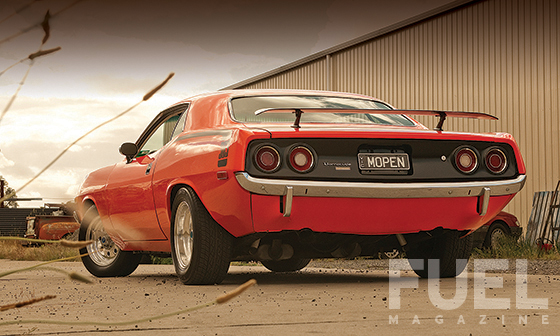
Refreshing our memory however, is Mark Griffin, the proud owner of a ’72 Vitamin C orange Plymouth ‘Cuda that he picked up a few years back at Flemington Car Show. “I’d been searching for something like it for quite some time, saw it at the car show and just had to have it, basically. I’d always wanted one and said to my wife that we should go down and have a look at the All American day. I joked “My car might be there,” but there was one there for sale and I said to her “I just have to have it! I pulled out all stops, got the money together and it was a done deal.” Lucky man. The car has now become a part of the family and any notions of selling it are quickly hushed by Mark’s wife!
The car had survived well and apart from new extractors (the old ones were dragging on the ground) and a quick interior tidy up, Mark reckons it’s been pretty smooth sailing. Imported ten or so years ago, it needed a few tweaks to conform to Australian standards (new sun visors, rewiring, lighting, seatbelts) “I did what I had to to get it on the road and then changed it all back to original one it was registered.” Says Mark. “It’s all fairly original, which is how I’d like to keep it. I’m pretty happy with it now. I’d like to get a full respray in the factory orange and as with all Mopars, there’s a few little rust bubbles here and there that I’d like to tidy up. It’s pretty kid friendly now, we get the family in it and go for a cruise, I don’t have to worry about it getting marked. It’s a fairly useable sort of car. It’s got a nice fresh 383, and I haven’t had to chase much body wise. I got an original radio for the dash and replaced things like indicators that were looking a bit tired, but it’s been really good. I was having trouble keeping the battery charged, but once I got the new alternator, I can just jump it it, turn the key and drive it. It rarely gives me any trouble.”
So why the ‘Cuda? “I’d always liked the Chevs and other American cars, but they were getting a bit common. I wanted something that no one else had around town. There’s not too many about. I was looking around for about eighteen months before I found this one. I’d always driven Holdens but when I found this Plymouth, I was converted.” There are no plans to change too much on the car. “I’m a bit of a purist when it comes to old cars” says Mark “I like to keep them fairly original, something to pass on to the youngsters down the track.”
Mark reckons the car gets its fair share of attention on the road. “I love it. Everyone stops and stares, they give me the thumbs up, they all drool over it. It’s really popular out on the road and at the car shows I joke to my wife that my cheeks hurt from smiling with all the photos that get taken of it!” Even burnouts on his mum’s street are met with approval. “I took my nephew out for a birthday drive and as a treat, lit up the tyres for him outside my mum’s place. I got out of the car and I thought she’d go crook but she just loved it.” And why wouldn’t you? With a tough 383 under the bonnet and the bulletproof combo of the 727 auto and Dana diff, It’s great to see a muscle car being used as intended, rather than wrapped in cotton wool and hidden away. While the fun nazis may have ended one of the greatest muscle car dynasties over 30 years ago, Mark is flying the Mopar flag high and reminding us what was muscle cars are all about and that what makes this one cool ‘Cuda.
0